
Chepstow Castle: Britain's oldest surviving stone castle, on a cliff above the Wye
Begun within a year of the Norman Conquest and added to for six centuries, Chepstow Castle strings the whole history of castle building along one limestone cliff above the River Wye.
See it from the river first. Walk down to the old iron road bridge over the Wye and look upstream: the castle runs along the top of a limestone cliff like a stone ship, its walls growing straight out of the rock, with the brown tidal river sliding past below. The Normans chose this spot in 1067, barely a year after Hastings, and nobody has ever improved on it.
Why Chepstow matters
Chepstow Castle is often described as the oldest surviving post-Roman stone fortification in Britain. While most early Norman castles were thrown up in earth and timber, William FitzOsbern, one of William the Conqueror's closest companions, began building here in stone from the start, guarding the main crossing from England into south Wales. Over the next six centuries each new owner added a piece, so a walk from the bottom of the castle to the top is a walk through the whole story of castle building.
It is also a manageable castle. Long and narrow rather than sprawling, it can be seen properly in an hour and a half, and the town around it has a medieval wall, a riverside and good connections by train and bus. For a first Welsh castle on the way in from England, it is hard to beat.
Six centuries in one long line
FitzOsbern's castle was first known as Striguil. His Great Tower, a rectangular hall-keep probably completed by about 1090, still stands at the heart of the site, and some of its blocks are thought to have been reused from the Roman town at Caerwent nearby.
The next great builder was William Marshal, the celebrated knight and regent of England, who held Chepstow from the 1190s. He built the present main gatehouse and strengthened the middle of the castle with round towers. In the 1270s and 1280s Roger Bigod, Earl of Norfolk, turned it into a comfortable lordly residence, adding a fine range of domestic buildings in the Lower Bailey, the town's Port Wall (about 1274-78) and the great tower at the south-east corner.
That tower takes its name from Henry Marten, one of the men who signed Charles I's death warrant. After the Restoration he was imprisoned at Chepstow until his death in 1680. By then the castle had seen real fighting: it was held for the King in the Civil War, besieged in 1645 and again in 1648, and finally taken by Parliamentary forces on 25 May 1648. A memorial to the Royalist commander, Sir Nicholas Kemeys, who was killed in the final assault, can be found in the castle.
The garrison was disbanded in 1685 and the buildings were left to decay, just in time for the fashion for "Picturesque" travel. By the late 18th century Chepstow was the start or end point of the Wye Tour, the boat trip down the valley that drew artists and poets. The ruin passed into state care in 1953 and has been looked after by Cadw since 1984.

Tours and tickets: Chepstow Castle
 Bestseller3 h 30 minFrom Barry Island: Gavin and Stacey Tour4.9(520)from£45
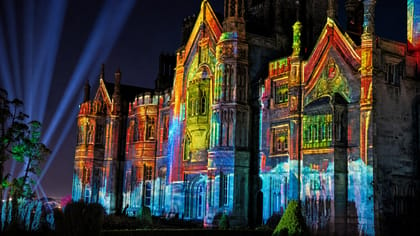 1 h 30 minMargam: Christmas Light Trail at Gothic Castle Entry Ticketfrom£26.75
 1 hourBetws-y-Coed: UK's longest alpine coaster (Fforest Coaster)4.5(50)from£31
Prices and availability from GetYourGuide. We may earn a commission if you book.
Walking the castle from bottom to top
The castle climbs gently along its ridge from east to west, so follow it in order and the centuries unroll in sequence.
Marshal's gatehouse and the doors
You enter through William Marshal's twin-towered gatehouse, still the main way in. Its great timber doors, made of oak and elm boards nailed together, have been dated by tree rings to between 1159 and 1189, and Cadw believes they are the oldest surviving castle doors in Europe. They hung in the gateway until 1962 and are now displayed under cover inside the castle, with replicas in the gate itself, so make a point of finding the originals: few objects bring the medieval castle so close.
Lower Bailey and Bigod's domestic range
Inside the gate, the Lower Bailey holds the remains of Roger Bigod's hall, kitchens and service rooms, set along the cliff edge with windows looking straight down on the Wye. Marten's Tower stands at the corner.
Middle Bailey and the Great Tower
Further up, the castle narrows to FitzOsbern's Great Tower, the oldest part. Inside the shell you can trace where later owners heightened and remodelled FitzOsbern's plain Norman walls, a building literally layered by time.
Upper Bailey and the far end
Beyond the Great Tower the ridge carries on to the Upper Bailey and the western defences, which look over the Dell, the green valley on the castle's landward side. From here the view back along the whole length of the castle is the best photograph on site.

On screen and on stage
A castle this photogenic was always going to be used by film crews. It appears in Terry Gilliam's Jabberwocky (1977) and in the 1980s television series Robin of Sherwood, and it featured in a broadcast for the Doctor Who 50th anniversary. In 1993 the Brazilian metal band Sepultura recorded part of an album here. Cadw also uses the castle for events, so check its programme for 2027 before you go.
Tickets and opening times
Chepstow Castle is run by Cadw, the Welsh Government's historic environment service. It is open all year. Cadw's winter hours (1 November to 28 February) are 10am to 4pm, and the castle closes on 24, 25 and 26 December and 1 January. Admission is charged, with a small discount for booking online; Cadw members go free, and Cadw sells individual, joint and family membership if you plan to visit several of its sites. Cadw's website does not allow automated checks, so we could not confirm this season's adult price: look it up before you go.
Allow 60 to 90 minutes. The site is on several levels with steps and slopes, though much of the Lower Bailey is reasonably level. On a busy summer Saturday, arrive early or late in the day; on a winter weekday you may have it almost to yourself.
Getting there by train, bus and car
By train: Chepstow station is on the line between Cardiff, Newport and Gloucester, with Transport for Wales services, and the castle is a short walk downhill through the town. It is a good stop for anyone arriving in Wales from the English Midlands; our guide to getting to Wales from England has the bigger picture.
By bus: Chepstow bus station is the hub for Newport Bus routes. The 69 runs up the Wye Valley via Tintern to Monmouth, with about four journeys a day on the late 2026 timetable, and the TrawsCymru T7 links Chepstow with Bristol in under an hour. Times are on Traveline Cymru, and our bus guide for Wales covers tickets and passes.
By car: Chepstow is just off the M48, the old Severn Bridge crossing, and on the A466 Wye Valley road. There are pay car parks in the town centre close to the castle.
Eating and staying
For food, head into the town centre, a few minutes' walk up the hill, which has cafés, pubs and bakeries, and the riverside by the old bridge is the place to eat a takeaway with the castle in view. Across the road from the castle, Chepstow Museum tells the story of the town and the Wye Tour.
There is no town page for Chepstow on this site yet. Cardiff is a short train ride away with the biggest choice of hotels in Wales: see places to stay in Cardiff. If you prefer the country, the Wye Valley has inns and guesthouses in and around Tintern and Monmouth.
Combine it with
Chepstow is the gateway to the Wye Valley and Monmouthshire. Take the 69 bus or drive the A466 north to Tintern Abbey, the Cistercian ruin that drew the Wye Tour artists, and carry on to Raglan Castle, a late medieval palace that makes the perfect contrast with Chepstow's Norman bones. Castle collectors heading west can add Caerphilly Castle, the largest in Wales, on the way to Cardiff, but not this winter: it is closed from 30 November 2026 while Cadw installs a new bridge, with reopening planned by Easter 2027.
Chepstow Castle on video
Chepstow Castle: questions people ask
How old is Chepstow Castle?
Are the original castle doors still there?
Can I get to Chepstow Castle by train?
Is Chepstow Castle open in winter?
How do I get from Chepstow to Tintern Abbey?
Chepstow Castle on the map
Nearby attractions

Tintern Abbey (Abaty Tyndyrn)
Wales's first Cistercian abbey stands roofless on a bend of the Wye. Here is what to see, what the current repairs mean for your visit, and how to get there by bus.

Raglan Castle (Castell Rhaglan)
Built by ambitious Welsh lords in the fifteenth century and wrecked after one of the last sieges of the Civil War, Raglan is a palace in fortress clothing, and a ruin with real presence.

Big Pit National Coal Museum
Free to enter, with a guided descent 90 m into a real colliery. What the underground tour involves, what it now costs, and how to fit Blaenavon's World Heritage landscape around it.

Caerphilly Castle
Thirty acres of walls, dams and lakes in a Valleys town, with a tower that out-leans Pisa. Closed this winter for a new bridge; Cadw plans to reopen by Easter 2027.

Cardiff Bay
Coal built it, a barrage reinvented it. The best way to see the old Tiger Bay docks is on foot, from the Millennium Centre out across the barrage to Penarth.

Cardiff Castle
A Roman fort, a Norman keep and some of the most lavish Victorian interiors in Britain, all inside one wall in the middle of the capital. Here is how to see the best of it.
If you like Chepstow Castle
Tintern Abbey (Abaty Tyndyrn)
Wales's first Cistercian abbey stands roofless on a bend of the Wye. Here is what to see, what the current repairs mean for your visit, and how to get there by bus.
Raglan Castle (Castell Rhaglan)
Built by ambitious Welsh lords in the fifteenth century and wrecked after one of the last sieges of the Civil War, Raglan is a palace in fortress clothing, and a ruin with real presence.
Caerphilly Castle
Thirty acres of walls, dams and lakes in a Valleys town, with a tower that out-leans Pisa. Closed this winter for a new bridge; Cadw plans to reopen by Easter 2027.