
Tenby: medieval walls, four beaches and the boat to Caldey
A walled medieval town on a headland, with a sheltered beach for every wind, a monks' island offshore and a railway station ten minutes from the sand.
At low tide the fishing boats in Tenby harbour lie tipped on their sides in the sand, ropes slack, while the pastel terraces above them catch the morning light like a row of paint samples. Somebody is always walking a dog along the harbour wall, somebody else is queuing for the Caldey boat, and the gulls have already worked out who is carrying chips. It is the most photographed view in Pembrokeshire, and for once the photographs undersell it, because they miss the smell of seaweed and the slap of water against the slipway.
Tenby (Dinbych-y-pysgod in Welsh, usually translated as "fortlet of the fish") is a medieval walled town squeezed onto a limestone headland, with a beach on either side and two more tucked under its cliffs. It is busy, unapologetically seaside and, in August, very full. It is also one of the few British resorts where the old town is genuinely old, and where you can arrive by train, walk to the sand in ten minutes and never miss a car.
A town built for trouble
The walls that still wrap the western side of the old town went up in the 13th century. After a Welsh attack in 1260, William de Valence, Earl of Pembroke, ordered them completed, and two centuries later Jasper Tudor agreed to split the cost of strengthening them with the town's merchants: the ditch was widened and the walls raised. In 1471, during the Wars of the Roses, Jasper's teenage nephew Henry Tudor sheltered in Tenby before slipping away to exile in Brittany. He came back fourteen years later and left as Henry VII.
The best surviving piece of all this is the Five Arches, the barbican gate on South Parade, where traffic and pedestrians still squeeze through the medieval stonework. Walk the length of the walls from there towards the Esplanade and you get a sense of how small the walled town really was.
Tenby has a habit of producing clever people. Robert Recorde, the Tudor mathematician who invented the equals sign (he introduced it in his 1557 book The Whetstone of Witte "to avoid tedious repetition"), was born here around 1512. The painter Augustus John was born here in 1878, and work by him and his sister Gwen John hangs in the town museum.

The four beaches, and which one to pick
Tenby's great trick is that whatever the wind is doing, one of its beaches is sheltered. Lifeguards have patrolled North, Castle and South beaches in recent summers; check the RNLI's beach finder for the current season before you swim.
North Beach
The town's postcard beach, a curve of sand below the cliffs with Goscar Rock standing in the middle of it. It catches the morning sun and is the closest beach to the station. Dogs are banned outright here from 1 May to 30 September.
Harbour Beach
A small, sheltered scoop of sand inside the harbour, good for small children and for watching the boats come and go. At high tide it more or less disappears.
Castle Beach
Tucked under Castle Hill, facing St Catherine's Island and its Victorian fort (work on this Palmerston fort began in 1867). The Sunday Times named it the best beach in the UK in 2019. At low tide you can walk across the sand to the island, but the fort itself is private and its opening for tours has come and gone over the years, so do not plan around it, and keep an eye on the tide.
South Beach
The long one, running south towards Giltar Point and backed by dunes and the golf course. It is the beach to choose on a crowded day, because even in August there is room further along. Castle and South Beach have partial dog restrictions in summer; the council publishes maps of exactly where.
Tours and tickets: Tenby
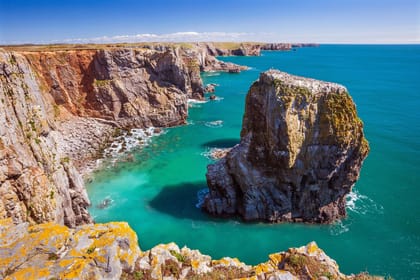 5 daysFrom London: Wales 5-Day Group Tour4.7(56)from£783.50
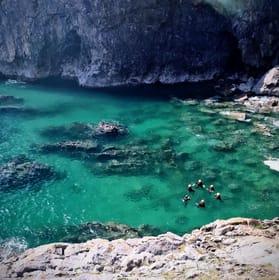 2 h 30 minTenby: Family Coasteering Adventure4.9(19)from£65
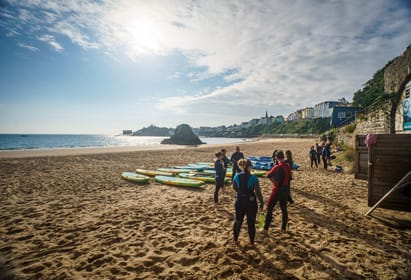 2 hoursPembrokeshire: Paddle Boarding At Tenby North Beach4.9(21)from£45
Prices and availability from GetYourGuide. We may earn a commission if you book.
Inside the walls
The old town is a grid of narrow streets, Georgian and Victorian frontages, ice cream shops and pubs, with a few places worth stepping inside.
- Tudor Merchant's House. On Quay Hill, a late 15th-century stone house and the oldest house still standing in Tenby. Tenby Corporation gave it to the National Trust in 1938. It is small and best enjoyed slowly, with painted cloths and furnished rooms that show how a prosperous trading family lived. Opening is seasonal and it often runs special Christmas openings, so check the National Trust page before you go. Dogs are not allowed and there is no parking at the house.
- Tenby Museum and Art Gallery. On Castle Hill, founded in 1878 and the oldest independent museum in Wales. Its collections run from local geology and archaeology to maritime history, with a gallery that includes the Johns. It is a charity and charges admission; hours are shorter in winter.
- St Mary's Church. A large 15th-century parish church in the middle of town, and a cool, quiet escape from Tudor Square on a hot afternoon.
- Castle Hill. Only scraps of the castle remain, but the headland gives the best all-round view of the town, both harbours and Caldey. The lifeboat station below dates from 2008 and replaced the 1905 slipway station next to it.
Caldey Island and the monks
Caldey lies a short boat ride south of the harbour, and it is still home to a community of Cistercian monks. Visitors come for the island's walks, beaches, lighthouse and abbey church, and for a few hours of a quiet that Tenby in August cannot offer. Boats leave from Tenby harbour, and tickets are sold from the blue Caldey Island kiosk in Castle Square.
The 2026 season ran from 4 April to 30 September, and the island is now closed until Easter 2027. Sailing days vary (in 2026 the island opened on Sundays only during the school holidays), tickets are sold on the day of travel only, and everything depends on the sea. In November 2026 the return trip was listed at £24.95 for adults and £12.95 for children, with a £64.95 family ticket; check the official Caldey Island website for 2027 dates and fares before you plan a day around it.

When to go, and how long to stay
July and August are loud, bright and crowded, with the beaches at their best and the streets at their fullest. June and September give you most of the warmth with fewer people, though one weekend in September belongs to Ironman Wales, when the triathletes and their supporters fill the town and road closures spread across south Pembrokeshire. Book accommodation well ahead for that weekend or avoid it.
Winter is underrated. The beaches are empty and walkable, the light is low and gold, and enough pubs and cafés stay open to make a weekend work, although Caldey and the summer buses stop. Check the Tenby weather forecast before a winter trip: south-westerly gales arrive fast.
A day covers the old town, a beach and the walls. Two or three days lets you add Caldey, a stretch of the coast path and a trip to the Stackpole beaches.
Getting there without a car (and with one)
Tenby station sits at the top of the town, a ten-minute walk from North Beach. It is on Transport for Wales's Pembroke Dock branch of the West Wales line, with trains roughly every two hours each way and fewer on Sundays; eastbound trains run to Whitland, Carmarthen and Swansea, which is about an hour and a half away. Some journeys run through from further afield, so use a journey planner rather than assuming you need to change. Our guide to trains in Wales covers tickets and railcards.
By bus, First Cymru's 349 links Tenby with Pembroke and Pembroke Dock on the way to Haverfordwest, and the X49 and 381 run to Haverfordwest via Narberth. In summer the open-top Tenby Coaster runs to Saundersfoot (in 2026 it ran daily from 30 May to 30 August; 2027 dates had not been published by November 2026).
By car, Tenby is reached on the A478 from the A477. The streets inside the walls are restricted in summer, so use the large pay car parks on the edge of town and walk in. In August, arrive before 10:00 or expect to queue.
Eating and staying
Tenby eats the way seaside towns should: fish and chips on the harbour wall, crab sandwiches, ice cream in quantities that would worry a dentist, and a good spread of pubs and restaurants in and around Tudor Square. In high summer book a table for dinner or eat early; in winter some places shut midweek.
The town has a deep stock of guesthouses, seafront hotels and holiday flats, many in the Georgian terraces above the harbour. Browse hotels in Tenby with live prices; filter for dog-friendly rooms if you are bringing a dog for the winter beaches.

Combine it with
- The coast path. Tenby sits on the final stretch of the Pembrokeshire Coast Path, which ends a few miles north-east at Amroth. Walk to Saundersfoot and take the bus back.
- Stackpole and Barafundle. The dune-backed cove at Barafundle Bay is about half an hour's drive west, beyond Pembroke.
- Laugharne. Dylan Thomas's estuary town is an easy hop over the county border: see our guide to Laugharne and the Dylan Thomas Boathouse.
- Skomer. The puffin island off the far west of the county is a long day trip by car from Tenby, but worth it in May or June.
For boat trips, coasteering and guided walks, browse things to do in Pembrokeshire, or step back to the Pembrokeshire area guide for the bigger picture.
Tenby on video
Tenby: questions people ask
Can you get to Tenby without a car?
Are dogs allowed on Tenby beaches?
When can you visit Caldey Island?
Can you walk to St Catherine's Island?
Is Tenby worth visiting in winter?
Tenby on the map
Nearby attractions

Pembrokeshire Coast Path
Wales's first National Trail runs 186 miles from St Dogmaels to Amroth. Here is how to walk it, in a fortnight or one glorious day at a time.

Barafundle Bay
A dune-backed cove between limestone headlands, half a mile from the nearest car park and with nothing on it but sand. Go early, bring a picnic, and carry it all out again.

Laugharne & Dylan Thomas Boathouse
Dylan Thomas spent his last four years in a cliffside house above the Taf estuary. The Boathouse is due a winter refit, so check it is open, but his Laugharne is there to walk all year.

Rhossili Bay & Worm's Head, Gower
Three miles of sand, a wreck, a whaleback hill and a rocky island you can only reach at low tide. How to plan a day at Gower's western tip, and how not to get cut off.

National Botanic Garden of Wales
Norman Foster's giant glass dome holds the flora of six Mediterranean climates, set in 568 acres of Carmarthenshire meadow and parkland. Best of all on a wet winter's day.

Skomer Island
Over 40,000 puffins nest on this island off the Marloes peninsula, many of them beside the path. Here is how to get a landing, and what to do when you are there.
If you like Tenby
Barafundle Bay
A dune-backed cove between limestone headlands, half a mile from the nearest car park and with nothing on it but sand. Go early, bring a picnic, and carry it all out again.
Pembrokeshire Coast Path
Wales's first National Trail runs 186 miles from St Dogmaels to Amroth. Here is how to walk it, in a fortnight or one glorious day at a time.

St Davids & St Davids Cathedral
Britain's smallest city hides a 12th-century cathedral in a hollow, a bishop's palace fit for a prince and, ten minutes' walk away, some of the wildest coast in Wales.