
Laugharne and the Dylan Thomas Boathouse: the poet's last harbour on the Taf
Dylan Thomas spent his last four years in a cliffside house above the Taf estuary. The Boathouse is due a winter refit, so check it is open, but his Laugharne is there to walk all year.
At low tide the Taf estuary below Laugharne turns into a sheet of silver mud stitched with channels, and the herons stand in it as if they were paid by the hour. Dylan Thomas looked at this view from a cliff-hung house for the last four years of his life and called it his "heron-priested shore". The house is still there, the herons are still there and, under a plain white cross in the churchyard up the hill, so is the poet.
Why Laugharne is worth the detour
Laugharne (Talacharn in Welsh) is a small town of Georgian houses, a ruined castle and one long street that tips downhill to the water. It would be pleasant without Thomas. With him it becomes the most complete literary pilgrimage in Wales: you can stand where he wrote, drink where he drank, walk the hillside he turned into a poem and finish at his grave, all inside a mile or so.
It is also quieter than you might expect. Coach parties come in summer, but outside July and August you can have the estuary path to yourself, with oystercatchers and curlews for company and Sir John's Hill rising behind. If you only know Thomas through Under Milk Wood read aloud at school, an afternoon here makes the language click: the place really does sound like that.
Four years on Cliff Road
Thomas first came to Laugharne in the 1930s and lived in the town more than once, but the Boathouse years were 1949 to 1953. The house was bought for him by Margaret Taylor, first wife of the historian A. J. P. Taylor, and he moved in with his wife Caitlin and their children. Money was always short and the household chaotic, yet this was a productive late period. "Over Sir John's Hill", his poem about the hawk and the estuary, comes straight out of the view from the window; parts of Under Milk Wood were worked on here too, though recent research suggests far less of it was written in Laugharne than the legend claims.
He died in New York on 9 November 1953, aged 39, and was buried in St Martin's churchyard in Laugharne later that month. Caitlin, who outlived him by four decades, died in 1994 and shares the grave. The Boathouse was later acquired by Carmarthenshire County Council and opened to visitors; since 2023 it has been run by CofGâr, the council's museums service.

Tours and tickets: Laugharne & Dylan Thomas Boathouse
 Bestseller11 hoursFrom Manchester: North Wales, Snowdonia, and Chester Tour4.8(1,936)from£76.33
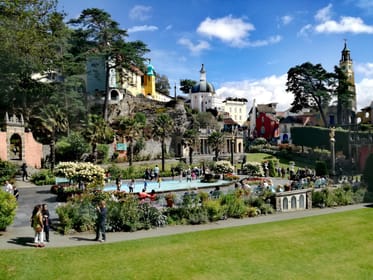 Bestseller9 hoursFrom Llandudno: Portmeirion, Snowdonia and Castles Tour4.8(557)from£65
 9 h 30 minFrom Cardiff: The Wandering Bard's Mythical West Wales Tour4.7(26)from£110
Prices and availability from GetYourGuide. We may earn a commission if you book.
Walking Dylan's Laugharne
The best way to see everything is a loop on foot. Start in the town, take Dylan's Walk along the cliff to the Boathouse, come back the same way and climb to the church. Allow two hours at a dawdle, longer if the Boathouse is open and you stop for tea.
The writing shed
Coming along Dylan's Walk from town, the first thing you reach is the little wooden shed perched above the estuary. This was his work room, where he wrote most of what he produced in these years. The interior has been reconstructed with a desk, papers and the clutter of a writer who never tidied, and it is the single image most visitors carry away. Expect to share the view with whoever else is on the path.
The Boathouse
A steep flight of steps drops from the lane to the house, which clings to the rock at the water's edge. When it is open you can see the family living room laid out as it was and displays on Thomas's life. Listen out for his recorded voice if it is playing: that rolling, theatrical baritone reading his own lines in the house where some of them were made. The lower floor has traditionally held a tearoom with a terrace over the estuary. Once the planned refit is done, the top floor will have a new exhibition space and family displays.
St Martin's churchyard
Thomas's grave is not in the church itself but out in the newer part of the churchyard, marked by a simple white wooden cross with his name on one side and Caitlin's on the other. It is often decorated with pens, pebbles and scraps of verse. The cross is replaced from time to time, so do not be surprised if it looks freshly painted. The church is a short walk north of the town centre, up the main road.
Laugharne Castle
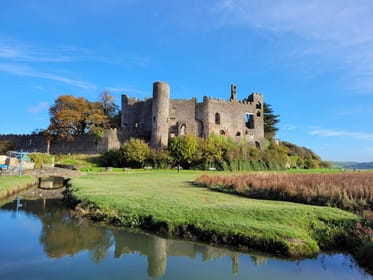
The castle at the bottom of town is a Norman stronghold later turned into a Tudor mansion, now a romantic ruin looked after by Cadw. Thomas knew it well: the novelist Richard Hughes lived in the adjoining Castle House in the 1930s, and Thomas is said to have written in its garden summerhouse. It is a seasonal site, open from spring to autumn and not every day of the week, so in winter you will be looking at it from the foreshore; check Cadw's page for 2027 dates, times and prices.
Sir John's Hill and the estuary paths
The hill behind the Boathouse is the "Sir John's Hill" of the poem, and a waymarked walk climbs over it with long views across the Taf to the Tywi and out to Carmarthen Bay. The Wales Coast Path also passes through Laugharne, and the official coast path site describes a circular walk from the town. Paths can be muddy from October to April, and the lower lanes flood on the biggest tides.

When to go and how long to allow
For the Boathouse, go between spring and autumn, once the 2027 opening hours are published. A low tide in the morning gives the best light on the mud flats and the most birds; a high spring tide fills the estuary to the brim and is dramatic in its own way, though it can cut off the shore car park. Thomas's birthday falls on 27 October, and literary events in and around Laugharne often cluster around that date and in spring, so check local listings if you want company or quiet.
In winter, whether or not the Boathouse is open, Laugharne still makes a good half day: the walk, the grave and a pub fire, with the castle seen from outside. Pack waterproofs whatever the season. For a feel of what the coast does in different months, see the Tenby weather and climate guide, the nearest of our forecasts.
Tickets, hours and access
Entry to the Boathouse is paid; the town, the shed exterior, the churchyard and the paths are free. CofGâr's most recent listing gives adult admission at £6, students and disabled visitors £5.50, children aged 5-18 £3 and under-5s free, with opening Thursday to Monday, 10.30am to 3pm. These figures predate the refurbishment, so treat them as a guide and check the official page before you go: hours have historically been longer in summer and daily in school holidays.
Access needs some thought. The Boathouse has no parking of its own because the lane is too narrow. Dylan's Walk is sloping and uneven, there is a steep flight of steps down to the entrance and more stairs inside. CofGâr publishes an accessibility guide, which is worth reading before you go, or phone ahead to ask about toilets and the steps.
Getting there by bus, train and car
The nearest railway station is Carmarthen, on the line from Swansea to West Wales. From Carmarthen bus station, bus 222 run by Taf Valley Coaches goes to Laugharne and on to Pendine, taking about half an hour. The timetable for late 2026 shows around five journeys each way, Monday to Saturday, with no Sunday service; current times are on Traveline Cymru. Our guide to buses in Wales explains how local routes and tickets work.
By car, Laugharne is reached from the A40 at St Clears. The car parks are by the water: the one on the Grist by the castle and the Green Banks car park are both prone to flooding at high tide, so check tide times before leaving the car for the afternoon. From either, the Boathouse is a walk of 10 to 15 minutes.
Where to eat and stay
When the Boathouse is open, its tearoom is the classic stop: a pot of tea and Welsh cakes on the terrace above the water. In town there are pubs and cafés along King Street, including Brown's Hotel, the poet's favourite drinking haunt. Opening hours in small towns shrink in winter, so do not count on a late lunch on a Monday in January.
Laugharne has a few rooms of its own, but most visitors base themselves along the coast. Tenby is about half an hour's drive west, with far more choice: browse hotels and guesthouses in Tenby. Carmarthen, the nearest bus and rail hub, is the practical option without a car.

Combine it with
Laugharne sits in the quieter western half of Carmarthenshire, and pairs well with a day under glass at the National Botanic Garden of Wales, about 40 minutes' drive east. Heading west, the walled harbour town of Tenby and the beaches of south Pembrokeshire make a natural next stop. Thomas fans should also follow him to Swansea, his birthplace, and out to Rhossili and the Gower coast, which he loved.
Laugharne & Dylan Thomas Boathouse on video
Laugharne & Dylan Thomas Boathouse: questions people ask
Is the Dylan Thomas Boathouse open?
Can I still see the writing shed while the Boathouse is closed?
Where is Dylan Thomas buried?
How do I get to Laugharne without a car?
Is there parking at the Boathouse?
Laugharne & Dylan Thomas Boathouse on the map
Nearby attractions

Pembrokeshire Coast Path
Wales's first National Trail runs 186 miles from St Dogmaels to Amroth. Here is how to walk it, in a fortnight or one glorious day at a time.

Tenby
A walled medieval town on a headland, with a sheltered beach for every wind, a monks' island offshore and a railway station ten minutes from the sand.

National Botanic Garden of Wales
Norman Foster's giant glass dome holds the flora of six Mediterranean climates, set in 568 acres of Carmarthenshire meadow and parkland. Best of all on a wet winter's day.

Rhossili Bay & Worm's Head, Gower
Three miles of sand, a wreck, a whaleback hill and a rocky island you can only reach at low tide. How to plan a day at Gower's western tip, and how not to get cut off.

Barafundle Bay
A dune-backed cove between limestone headlands, half a mile from the nearest car park and with nothing on it but sand. Go early, bring a picnic, and carry it all out again.

New Quay & Cardigan Bay dolphins
Bottlenose dolphins feed off New Quay's harbour wall all year, most often from spring to autumn. Watch from the pier for free or join a boat trip, then walk the cliffs Dylan Thomas knew.
If you like Laugharne & Dylan Thomas Boathouse
National Botanic Garden of Wales
Norman Foster's giant glass dome holds the flora of six Mediterranean climates, set in 568 acres of Carmarthenshire meadow and parkland. Best of all on a wet winter's day.
Tenby
A walled medieval town on a headland, with a sheltered beach for every wind, a monks' island offshore and a railway station ten minutes from the sand.
Rhossili Bay & Worm's Head, Gower
Three miles of sand, a wreck, a whaleback hill and a rocky island you can only reach at low tide. How to plan a day at Gower's western tip, and how not to get cut off.