
St Davids: the cathedral in the hollow and the coast at the end of Wales
Britain's smallest city hides a 12th-century cathedral in a hollow, a bishop's palace fit for a prince and, ten minutes' walk away, some of the wildest coast in Wales.
The odd thing about St Davids Cathedral is that you cannot see it. Walk down the main street of Britain's smallest city and there is no spire on the skyline, no great west front at the end of the road. Then you pass under the old gatehouse, Porth y Tŵr, where the cathedral bells now hang, and the whole building is suddenly below you, sitting in a grassy hollow of the River Alun with the ruined Bishop's Palace beside it. It was put there, the usual explanation goes, to keep it out of sight of raiders coming in from the sea. Given that Vikings sacked the place more than once, the logic holds.
St Davids (Tyddewi, "David's house") is a village-sized city of about 1,750 people at the 2021 census, on the far western tip of Wales. It earns its city title from the cathedral, and its visitors from the cathedral plus one of the best stretches of coast in Britain, which starts about ten minutes' walk from the market cross.

The cathedral
Saint David, the patron saint of Wales, founded a monastery here in the 6th century and died in 589. Bishop Bernard consecrated a new cathedral in 1131, and the building you see now was begun in 1181. In the early 12th century Pope Callixtus II decreed that two pilgrimages to St Davids were worth one to Rome, which did wonders for the local economy for the next four hundred years.
What to look for
- The floor. It slopes uphill by nearly four metres from the west door to the east end, and the building is still settling. Stand at the back of the nave and you can see the pillars lean.
- The nave ceiling. A carved Irish oak ceiling of the 1530s, dark and intricate, best seen on a bright day when light comes through the clerestory.
- The shrine of St David. Stripped by Bishop Barlow in 1538, it was restored and re-dedicated in 2012, with new painted icons.
- The tombs. Rhys ap Gruffydd, the 12th-century ruler of Deheubarth, and the chronicler Gerald of Wales are buried here, along with Edmund Tudor, father of Henry VII.
- The cloisters. Rebuilt between 2003 and 2007 on the site of St Mary's College, founded in 1365.
Opening times and tickets
As listed in November 2026, the cathedral is open for visiting Monday to Saturday 10:00-16:00 and on Sundays 13:00-15:00, around services. There is no entry charge; the cathedral suggests a donation of £5 per adult. Guided "Tuesday Tours" start at the Welcome Desk at 12:45 every Tuesday and cost £10, with under-18s free; just turn up. Hand-held photography for personal use is free, but tripods need written permission and a fee, and filming the choristers is not allowed.
Most days there is a sung service, and hearing the choir in that sloping nave is worth timing your visit for. The weekly service list is on the cathedral website.
The Bishop's Palace
Across the Alun from the cathedral, the Bishop's Palace is a roofless ruin of real grandeur, largely the work of Bishop Henry de Gower in the 14th century. Look up at the arcaded parapets with their chequerboard stonework: this was a bishop who wanted to be seen to rank with princes. By the 17th century it was judged "beyond repair". It is now cared for by Cadw and charges admission; Cadw sets opening hours by season, with shorter hours in winter, so check the Cadw page for this season's times and prices. A Cadw Explorer Pass covers it if you are touring Welsh castles too.
Tours and tickets: St Davids & St Davids Cathedral
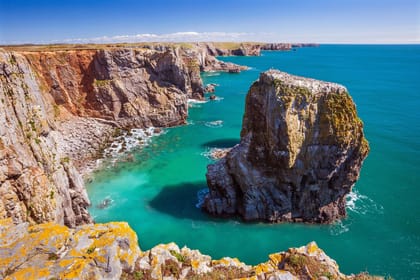 5 daysFrom London: Wales 5-Day Group Tour4.7(56)from£783.50
 7 daysCardiff: 7-Day Private Voyage of Wales with Driverfrom£4,000
 2 h 30 minTenby: Family Coasteering Adventure4.9(19)from£65
Prices and availability from GetYourGuide. We may earn a commission if you book.
Around the city
The city centre is small enough to walk in ten minutes: Cross Square with its market cross, a run of galleries, outdoor shops, pubs and cafés, and the cathedral close below.
Oriel y Parc, the National Park's gallery and visitor centre at the eastern edge of town, is the most useful stop for first-timers. Its gallery shows art and objects from the National Collection of Wales alongside local artists, and its Discovery Centre is the place to ask about walks, boats and bus times. As listed in November 2026, the shop and Discovery Centre open daily 9.30-16.30 and the main gallery 10:00-16:00, with a café in the building. It also has the main coach and car park.
The coast on the doorstep
This is the real reason to stay more than an afternoon. The St Davids peninsula is ringed by the Pembrokeshire Coast Path, and almost every lane out of the city ends at a cove.
St Non's and Porthclais
A short walk south of the city, the ruined Chapel of St Non marks the spot where David is said to have been born to Non around the year 500, during a storm. Her holy well is beside the path above St Brides Bay. Follow the coast west to Porthclais, the tiny harbour where, by tradition, David was baptised. Back to the city, it makes an easy loop of a couple of hours with stops.
Whitesands and St Davids Head
Whitesands (Porth Mawr), about two miles west, is one of the best surf beaches in Pembrokeshire and a fine family beach in summer, with lifeguards in recent seasons. Dogs are banned there entirely from 1 May to 30 September. From the north end, the path climbs onto St Davids Head, a headland of heather, Iron Age ramparts and rocks, with Ramsey and the Bishops and Clerks islets scattered offshore.
Ramsey Island
Ramsey, across the fierce tidal race of Ramsey Sound, is an RSPB reserve with cliffs up to 120 metres, a resident flock of choughs and breeding peregrines. In late summer and autumn grey seals pup on its beaches. Landing trips are run by Thousand Islands Expeditions and must be booked in advance; boats leave from St Justinian's, where there is summer pay-and-display parking and the St Davids lifeboat station. There are no wheelchair-accessible paths on the island and only compost toilets up a flight of steep steps. Several operators also run fast boat trips around Ramsey and out to the Bishops and Clerks without landing.

When to go
St Davids Day, 1 March, is the obvious date, when the cathedral is busy with services and the city wears daffodils. For walking, May and June bring sea pinks, gorse and long light; July and August are the busiest, and the Celtic Coaster runs at its most frequent; September is quieter, and in 2026 the Puffin and Strumble shuttles ran until 27 September. In winter the city is quiet, the cathedral is at its most atmospheric, and the Atlantic puts on a show. Check the St Davids weather forecast: this is the far western tip of Wales and the wind has nothing to slow it down.
Allow two hours for the cathedral and palace together. A full day adds a coast walk; two or three days let you add a boat trip, Skomer or a beach day.
Getting there
By bus and train. The nearest station is Haverfordwest, on Transport for Wales's line from Swansea and Carmarthen. From the station, Richards Bros' TrawsCymru T11 runs to St Davids via Newgale and Solva in about 50 minutes, then on to Fishguard. In the November 2026 timetable there were seven departures from Haverfordwest station on weekdays and Saturdays and no Sunday journeys, so check Traveline Cymru before a weekend trip. Our guide to buses in Wales explains tickets and passes.
Summer coastal buses. In summer St Davids is the hub of the Pembrokeshire coastal buses. In 2026 the Puffin Shuttle and Strumble Shuttle ran daily from 23 May to 27 September, and the Celtic Coaster ran its busiest timetable in the late-May half-term and through July and August:
- Celtic Coaster (403): loops around the peninsula to St Justinian's and Whitesands, half-hourly in half-term week and in July and August.
- Strumble Shuttle (404): St Davids to Fishguard along the coast road, via Abereiddi, Porthgain and Strumble Head.
- Puffin Shuttle (400): St Davids to Marloes and Martin's Haven for Skomer boats, via Little Haven and Broad Haven.
None of the three runs in winter. Pembrokeshire County Council gives the 2027 summer period as 29 May to 26 September 2027; check the council's coastal bus timetables for days and times.
By car. St Davids is 16 miles from Haverfordwest on the A487. There is no parking at the cathedral except pre-booked spaces for disabled drivers (book at least 48 hours ahead). Use the pay car parks at Oriel y Parc, Merrivale or Quickwell Hill and walk down.
Eating and staying
For a small place, St Davids eats well, with pubs, cafés and a couple of serious restaurants around Cross Square and the High Street. Inside the cathedral precinct, the Cathedral Coffee Shop (run by MamGu Welsh Cakes) opens 9.30-16:00 daily, and the café at Oriel y Parc is handy for an early start. In summer book dinner ahead; the city is small and fills up.
St Davids is the best base in north Pembrokeshire for the coast path and the islands, with inns, guesthouses and a handful of smart hotels. Compare hotels in St Davids with live prices, or the boutique stays in St Davids if it is a special trip.

Combine it with
Take the Puffin Shuttle south in May or June for Skomer Island and its puffins, or spend a day on the coast between Abereiddi's Blue Lagoon and Porthgain. For coasteering, kayaking and boat trips from St Davids, browse things to do in Pembrokeshire, and see the Pembrokeshire area guide for the rest of the county.
St Davids & St Davids Cathedral on video
St Davids & St Davids Cathedral: questions people ask
Is it free to visit St Davids Cathedral?
Why is St Davids a city if it is so small?
How do you get to St Davids by public transport?
Can you visit Ramsey Island?
Where do you park for St Davids Cathedral?
St Davids & St Davids Cathedral on the map
Nearby attractions

Skomer Island
Over 40,000 puffins nest on this island off the Marloes peninsula, many of them beside the path. Here is how to get a landing, and what to do when you are there.

Barafundle Bay
A dune-backed cove between limestone headlands, half a mile from the nearest car park and with nothing on it but sand. Go early, bring a picnic, and carry it all out again.

Pembrokeshire Coast Path
Wales's first National Trail runs 186 miles from St Dogmaels to Amroth. Here is how to walk it, in a fortnight or one glorious day at a time.

Tenby
A walled medieval town on a headland, with a sheltered beach for every wind, a monks' island offshore and a railway station ten minutes from the sand.

Laugharne & Dylan Thomas Boathouse
Dylan Thomas spent his last four years in a cliffside house above the Taf estuary. The Boathouse is due a winter refit, so check it is open, but his Laugharne is there to walk all year.

New Quay & Cardigan Bay dolphins
Bottlenose dolphins feed off New Quay's harbour wall all year, most often from spring to autumn. Watch from the pier for free or join a boat trip, then walk the cliffs Dylan Thomas knew.
If you like St Davids & St Davids Cathedral
Skomer Island
Over 40,000 puffins nest on this island off the Marloes peninsula, many of them beside the path. Here is how to get a landing, and what to do when you are there.
Pembrokeshire Coast Path
Wales's first National Trail runs 186 miles from St Dogmaels to Amroth. Here is how to walk it, in a fortnight or one glorious day at a time.
Tenby
A walled medieval town on a headland, with a sheltered beach for every wind, a monks' island offshore and a railway station ten minutes from the sand.