
The Powys borderlands: Welshpool, Montgomery, Lake Vyrnwy and Hay-on-Wye
Castles that once guarded the frontier, a steam railway into the hills, a Victorian lake and the book town of Hay, strung along the Welsh border.
In 1977 a bookseller called Richard Booth declared Hay-on-Wye an independent kingdom, with himself as king. It was a publicity stunt, but it caught something true about the Welsh border: this is country with a mind of its own, neither quite Wales nor quite England, where castles built to hold the frontier now look down on sheep, canals and some of the quietest market towns in Britain. Most visitors cross it on the way somewhere else. Slow down, and the Powys borderlands give you one of the great country-house gardens of Europe, two charming narrow-gauge railways, a Victorian lake and the world's most famous book town.
The March
For centuries this was the March, a frontier zone of Norman lordships between the Welsh princes and the English crown. Offa's Dyke, the 8th-century earthwork, still runs along much of it, and the Offa's Dyke Path follows the border for 177 miles from near Chepstow to Prestatyn. The landscape is rolling and green, with the Severn and Wye valleys cutting through hills that rise to open moor in the west. The towns are small, built of brick, stone and black-and-white timber, and are proud of their markets and festivals. Few of them have more than a few thousand people, and this is the most English-facing side of Mid Wales.

Welshpool and Powis Castle
Welshpool is the biggest town in the north of the area and the best base for its sights. Its glory is Powis Castle, a red-stone medieval fortress on a ridge above town, with the terraced Italianate gardens tumbling below and the Clive of India collection inside. The town is also the start of the Welshpool and Llanfair Light Railway, which has run 8.5 miles into the hills since 1903 and tackles Golfa Bank at a gradient of 1 in 29 on its way to Llanfair Caereinion. The Montgomery Canal passes through the middle of town and makes a gentle towpath walk.
Montgomery and the Severn valley
Montgomery is one of the prettiest small towns in Wales, with a Georgian town hall of 1748-51 and the ruins of a castle begun in 1223 on the ridge above. In the churchyard, the Robber's Grave belongs to a man hanged in 1821 who swore that grass would not grow on it for a hundred years, and the Old Bell Museum tells the town's story. Up the Severn, Newtown was the birthplace of the social reformer Robert Owen, and Llanidloes is a handsome market town with a timber-framed market hall.
Tours in Powys borderlands
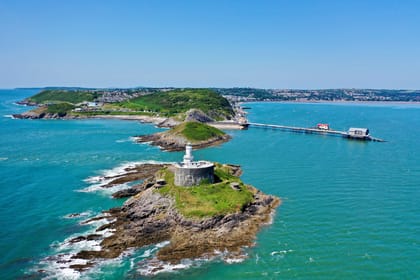 8 hoursCardiff/Swansea: Gower Peninsula's Cliffs & Mumbles Day Tour4.9(284)from£83
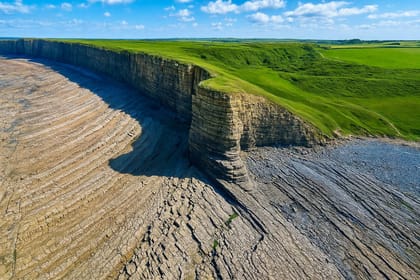 8 hoursCardiff: South Wales Cliffs, Beaches & Castles Day Tour4.9(284)from£62.25
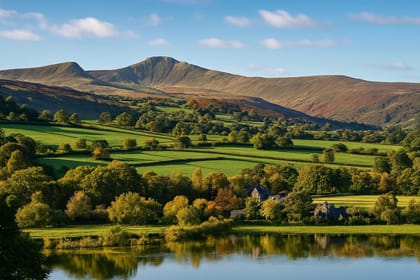 8 hoursCardiff: National Park, Waterfalls & Heritage Day Tour4.9(280)from£83
Prices and availability from GetYourGuide. We may earn a commission if you book.
North to Lake Vyrnwy
In the hills north-west of Welshpool, Lake Vyrnwy is a reservoir built for Liverpool between 1881 and 1888, which drowned the village of Llanwddyn. The lake is about 7.6 km long, with a Gothic straining tower standing in the water, and the estate is a nature reserve managed by the RSPB with Hafren Dyfrdwy, with bird hides and waymarked walks. Nearby, the waterfall of Pistyll Rhaeadr above Llanrhaeadr-ym-Mochnant is one of the most spectacular in Wales.
Knighton, Presteigne and the Dyke
Knighton, whose Welsh name means "the town on the Dyke", is the halfway point of the Offa's Dyke Path, and the Offa's Dyke Centre explains the earthwork and its walk. Some of the best-preserved sections of the Dyke are in the hills nearby. Presteigne, a few miles south, is a quiet old county town whose Judge's Lodging museum recreates Victorian court life.
Hay-on-Wye
At the southern end of the borderlands, Hay-on-Wye sits on the Welsh side of the border, with the Wye to the north and the Black Mountains rising behind. Since Booth opened his first shop in 1962, the town has become the world's best-known book town, with over twenty bookshops, although fewer than in its heyday. Hay Castle, restored and reopened in 2022, now has a gallery and viewpoint. The Hay Festival has run since 1988 and, in 2027, takes place from 27 May to 6 June, when the town's 1,675 residents are joined by tens of thousands of visitors. South of the town, the Gospel Pass road climbs past Hay Bluff into Bannau Brycheiniog (the Brecon Beacons).

Getting around without a car
The Cambrian line serves Welshpool and Newtown, with direct trains to Shrewsbury, Birmingham and Aberystwyth, and the Heart of Wales line calls at Knighton and Llandrindod Wells a few times a day. Between the towns, buses are thin: the TrawsCymru T12 from Machynlleth to Wrexham and the T14 to Hay and Cardiff were withdrawn in August 2025, though T4 still runs from Newtown south through Llandrindod and Builth to Brecon. Hay has no station; local buses link it with Hereford station and Brecon, a few times a day on weekdays. Lake Vyrnwy is realistically a car or bike trip. Plan on Traveline Cymru, and see our rail guide.
Where to stay
Hay-on-Wye has characterful inns and B&Bs, but rooms sell out months ahead for the festival. Welshpool and Montgomery have coaching inns and small hotels, and there are country-house hotels and farm stays across the area; our boutique stays page has the more stylish options.
Powys borderlands: practical questions
When is the Hay Festival in 2027?
How do you get to Hay-on-Wye by public transport?
Where is the halfway point of Offa's Dyke Path?
Is Powis Castle worth visiting?
Top attractions in Powys borderlands
See all →
Hay-on-Wye
The border town that a bookseller declared a kingdom in 1977: roughly two dozen bookshops, a castle opened to the public in 2022, and the Black Mountains on the doorstep.

Powis Castle & Garden
A Welsh prince's castle on a ridge above Welshpool, with four Baroque terraces cut into the rock beneath it and a controversial treasure-house of Indian objects inside.