
Llandudno and the Great Orme: pier, prom and a Bronze Age headland
A grand Victorian resort with a wild limestone headland on its doorstep. Ride the 1902 tram, walk the cliffs, then come down for the longest pier in Wales.
About 4,000 years before the first deckchair went out on Llandudno's North Shore, people were tunnelling into the headland above it with bone tools and stone hammers, chasing veins of copper. They dug more than 8 km of passages. The Victorians, who arrived much later with a pier, a promenade and a cable-hauled tram, were relative newcomers.
That is the thing about Llandudno. On the front it is a confident, cream-painted Victorian resort, all bow windows and bandstand nostalgia. Five minutes uphill it becomes something else entirely: the Great Orme (Y Gogarth), a 207 m lump of limestone with feral goats, rare butterflies, a Bronze Age mine and views across to Anglesey. Do both halves, and do them in the right order.
Two halves, one day
The Orme is about 3 km long and 1.5 km wide, a near-island joined to the mainland by the flat strip on which the town was built. Llandudno itself was laid out as a planned resort in the mid-19th century, with the grand curve of the North Shore promenade facing Llandudno Bay and the quieter, sandier West Shore on the other side looking towards Conwy. The headland is protected several times over: Site of Special Scientific Interest, Special Area of Conservation, Heritage Coast and country park.
Our recommended order on a dry day: up the Orme in the morning (by tram, cable car or on foot), lunch, then down to the pier and prom for the long light of the afternoon. On a windy day, swap it round and keep checking whether the cable car is running.

Getting up the Orme
The Great Orme Tramway
Britain's only remaining cable-operated street tramway has been climbing the Orme since 1902 (lower section) and 1903 (upper section), and it still uses its original cars, named after Welsh saints. It runs as two separate funicular sections, so you change cars at Halfway station, which is also a handy stop for the copper mines. The lower section climbs straight up through the streets at gradients as steep as 1 in 3.8, which is the part to film. The whole journey to the summit covers about a mile.
The trams run seasonally, normally from late March to late October, and the operator's website currently states that the tramway is closed until 2027. The fares it lists are £11.25 for adults and £8.05 for children aged 3-16, rising to £12.30 and £9.30 in July and August; 2027 dates and prices had not been announced by November 2026. The lower terminus, Victoria station, is on Church Walks, a short walk from the pier.
The cable car
The Llandudno Cable Car, opened in 1969, runs from Happy Valley gardens at the pier end of town to the summit, a ride of a little over 1.6 km, often billed as the longest passenger cable car in Britain. Expect it from Easter to the end of the October half-term. It stops in winds above about 22 mph, which on an exposed headland happens more often than you might hope, so treat it as a bonus, not a plan.
On foot
The free option is the best. Paths climb from Happy Valley and from near the tram station to the summit in roughly 45 minutes to an hour at a steady pace, with the view opening up behind you at every bend. Alternatively, walk all or part of Marine Drive, the four-mile one-way road around the cliffs opened in 1878, and cut up to the summit from the far side. Cars pay a toll at the gate; walkers use it free.
Tours and tickets: Llandudno & the Great Orme
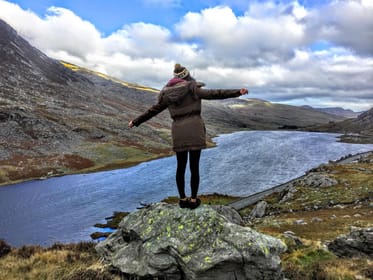 Bestseller9 hoursFrom Liverpool: North Wales Adventure Sightseeing Day Trip4.8(1,015)from£59
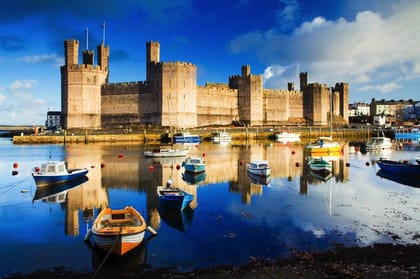 Bestseller9 hoursFrom Llandudno: Snowdonia National Park & Three Castles Tour4.9(281)from£65
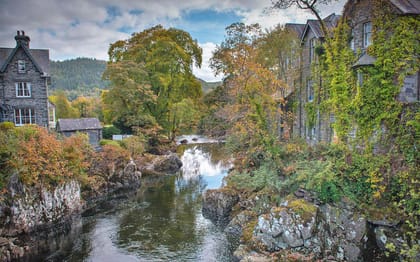 10 hoursFrom Liverpool: North Wales and Caernarfon Castle Tour4.7(256)from£56.25
Prices and availability from GetYourGuide. We may earn a commission if you book.
On the headland
Great Orme Mines
Excavation began in 1987 and the mines opened to visitors in 1991. The visitor route runs for about 200 m underground across two levels, with 35 steps down and back up, low ceilings, wet floors and a temperature of 5-8°C whatever the weather outside; hard hats are provided. 2026 prices were £13.75 adult, £8.25 child (5-15), £36.75 for a family of four, with under-5s free. The mines are closed for the winter apart from three December weekends (Friday to Sunday, 4-6, 11-13 and 18-20 December 2026); check their site before you go.
The summit and the wildlife
The summit complex has a café, bar and the top stations of both tram and cable car, and it is busy all summer. Walk five minutes in any direction and you are on open limestone grassland. Around 200 Kashmiri goats roam the headland, descended from a pair given to Queen Victoria; they are wild, unbothered and sometimes wander down into town. The Orme is the only known site in the world for the wild Great Orme cotoneaster, and has its own subspecies of silver-studded blue butterfly, on the wing in early summer. The National Trust bought Parc Farm on the summit in 2015 to manage it for wildlife.

The old lighthouse and St Tudno's
The former lighthouse on Marine Drive, built in 1862 and decommissioned in 1985, is now a guesthouse. Tucked into a hollow on the north side is the tiny church of St Tudno, the saint who gave the town its name. It is one of the most peaceful places on the north coast.
Back on the front: pier, prom and West Shore
Llandudno Pier is 700 m (2,295 ft) long, Grade II* listed and the longest in Wales. Its first section opened on 1 August 1877, and its ornamental kiosks and cast-iron railings are what most people come for, along with chips, arcades and the inevitable herring gulls. At the far end you can look back along the whole sweep of the bay to the Little Orme.
The promenade runs for well over a mile to the east, lined with tall Victorian hotels; it is a fine, flat walk at any time of year. For something calmer, cross town to the West Shore, which faces the Conwy estuary and Eryri. The Liddell family, whose daughter Alice inspired Lewis Carroll, had a holiday house here, and the town plays up the link with Alice-themed statues around the streets.

When to go
Llandudno sits in the rain shadow of the mountains. It gets a fraction of the rain that falls on the high ground of Eryri, and the town often stays dry when the mountains are in cloud. Check the Llandudno weather forecast before you choose your day.
- April to June: the best balance of long days, flowering limestone grassland and manageable crowds. The tram and cable car are both normally running.
- July and August: warmest, busiest and dearest. Arrive at the tram early.
- November to March: trams, cable car and mines are closed, but the Orme is open to walkers every day and the pier and prom have a bracing, empty charm. Winter storms make for good wave-watching on Marine Drive.
Plan a full day for town and headland; two if you want to add Conwy or Bodnant.
Getting there
By train
Llandudno station is in the town centre, at the end of a short branch from Llandudno Junction on the North Wales coast main line. From England you will usually change at Llandudno Junction. Conwy Valley line trains also run through to Llandudno: in the summer 2026 timetable (17 May to 13 September) there were six trains a day each way between Llandudno Junction, Betws-y-Coed and Blaenau Ffestiniog, Monday to Saturday, most of them starting or ending at Llandudno. Winter times differ and a new timetable starts on 13 December 2026, so check Transport for Wales. See our rail guide for routes and rover tickets.
By bus
Local buses link Llandudno with Conwy, Colwyn Bay and the rest of the coast. The 1Bws day ticket (£7.50 adult in 2026) covers almost every local bus in North Wales; details on our tickets and passes page.
By car
Leave the A55 at Llandudno Junction and follow the A470 into town. There is parking in the town centre and at the summit, which you can reach by the road that climbs alongside the tram line or via the Marine Drive toll road. On summer weekends the town centre clogs up; park once and use the tram or your feet.
Where to stay and eat
Llandudno has one of the widest choices of places to stay in North Wales, from grand seafront piles on the North Shore to small guesthouses in the side streets. Browse hotels in Llandudno; book well ahead for August and for big events. The best food is in the streets behind the prom rather than on it, and the summit complex is handy for a hot drink on the Orme.
For guided trips and boat rides from the town, see things to do in Llandudno.
Combine it with
- Conwy Castle and its town walls, about 15 minutes away by train, bus or car.
- Bodnant Garden in the Conwy Valley, famous for its late-May laburnum arch.
- The rest of Llandudno, Conwy and the north coast.
Llandudno & the Great Orme on video
Llandudno & the Great Orme: questions people ask
Is the Great Orme Tramway running in winter?
Can you drive up the Great Orme?
How long does it take to walk up the Great Orme?
Why is the Llandudno Cable Car closed?
Are the Great Orme Mines suitable for children?
Where do the Great Orme goats come from?
Llandudno & the Great Orme on the map
Nearby attractions

Conwy Castle (Castell Conwy)
Eight towers still at full height, a wall-walk over the estuary and a medieval town wall you can walk: Conwy is one of the most complete of Edward I's Welsh castles.

Bodnant Garden
Eighty acres above the Conwy valley: Italianate terraces, a wooded ravine and Britain's longest laburnum arch, which is not the only reason to go.

Beaumaris Castle
Edward I's most perfect design ran out of money before it reached full height. The result is a moated, symmetrical masterpiece on the edge of the Menai Strait.

Penrhyn Castle & Garden
A 19th-century mock-Norman castle near Bangor, paid for by Jamaican sugar and Welsh slate, with astonishing interiors and an honest account of where the money came from.

Zip World Velocity 2 (Penrhyn Quarry)
A mile-long, head-first zip line at over 100 mph across Britain's biggest slate quarry. Short, pricey and utterly memorable, with real history under your harness.

Betws-y-Coed & Swallow Falls
A cascade on the Afon Llugwy that is at its best after heavy rain, and the riverside village that has been the gateway to Eryri since the coaching days.
If you like Llandudno & the Great Orme
Conwy Castle (Castell Conwy)
Eight towers still at full height, a wall-walk over the estuary and a medieval town wall you can walk: Conwy is one of the most complete of Edward I's Welsh castles.
Bodnant Garden
Eighty acres above the Conwy valley: Italianate terraces, a wooded ravine and Britain's longest laburnum arch, which is not the only reason to go.
Betws-y-Coed & Swallow Falls
A cascade on the Afon Llugwy that is at its best after heavy rain, and the riverside village that has been the gateway to Eryri since the coaching days.