
Conwy Castle: eight towers, a walled town and the best battlements in Wales
Eight towers still at full height, a wall-walk over the estuary and a medieval town wall you can walk: Conwy is one of the most complete of Edward I's Welsh castles.
The carpenters who took a castle
On Good Friday 1401, with most of the garrison at church, two men turned up at the gate of Conwy Castle claiming to be carpenters. They were Rhys ap Tudur and his brother Gwilym, cousins of Owain Glyndŵr, and once inside they and their men seized the place. They held one of the strongest fortresses in Europe for about three months before negotiating a surrender and, remarkably, a royal pardon.
Stand in the outer ward today and the story makes more sense than it should. Conwy is a castle built to be unbreakable by force, and it never really was broken by force. Its eight great towers and two barbicans are still standing to their full height, its wall-walks are open, and the medieval town wall still runs right round the town it was built to protect. Few places in Britain give you such a complete picture of a planned 13th-century fortress town, and almost none let you climb over so much of it.

Built in four years, for a conquest
Edward I ordered the castle and the walled town in 1283, during his conquest of North Wales, and the work was essentially done by 1287. The man in charge was Master James of St George, a mason from Savoy who also designed Harlech and Beaumaris. Castle and town walls together cost around £15,000, a colossal sum for the time. The town was a plantation for English settlers; the Welsh community and the Cistercian abbey that stood here were moved upriver.
The castle was tested almost at once. During Madog ap Llywelyn's revolt, Edward himself was besieged here over the winter of 1294-95, supplied only by sea until relief arrived in February. In August 1399 Richard II met Henry Percy at Conwy to negotiate with Henry Bolingbroke's rebels; within days he had surrendered at Flint. Then came the carpenters of 1401.
In the Civil War the castle was held for the king until 1646, when it surrendered to Parliament after a siege. In 1655 Parliament's Council of State ordered it to be slighted, and in 1665 its iron and lead were stripped and sold. The result was the romantic ruin that drew painters such as Turner in the late 18th century. Restoration began in the 1860s, and since 1986 the castle and town walls have been part of the Castles and Town Walls of King Edward in Gwynedd World Heritage Site. Since 2024 Cadw has used the Welsh name, Castell Conwy, in English as well, so expect to see it on Cadw's signs and website.
Tours and tickets: Conwy Castle (Castell Conwy)
 Bestseller11 hoursFrom Manchester: North Wales, Snowdonia, and Chester Tour4.8(1,936)from£76.33
 Bestseller9 hoursFrom Liverpool: North Wales Adventure Sightseeing Day Trip4.8(1,015)from£59
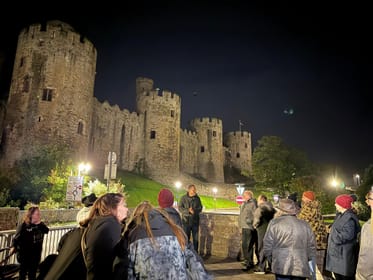 1 hourConwy: Ghost Tour of Haunted Houses and Dark History5.0(59)from£17
Prices and availability from GetYourGuide. We may earn a commission if you book.
What to see inside
The outer ward and Great Hall
You enter through the west barbican into the long outer ward, where the Great Hall ran along the south side. Its roof is long gone but the stone arches that once carried it survive, and you can trace the kitchens, the prison tower and the garrison buildings from their footings. Information panels are brief; Cadw's guidebook is worth buying if you like to know what each room was for.
The inner ward and the royal chambers
Beyond a cross wall lies the inner ward, the private royal quarters. Historians describe the rooms here as the best preserved suite of medieval private royal chambers in England and Wales. Look for the Chapel Tower, which held the king's own small chapel, with its carved stonework still crisp in places.
The towers and the wall-walk
This is the part people remember. Spiral stairs climb inside several of the towers to the battlements, and from the top you look straight down onto the estuary and the three bridges that cross it: Thomas Telford's road suspension bridge of 1826, Robert Stephenson's tubular rail bridge of 1848-49 and the modern road bridge of 1958. The stairs are narrow and uneven and the drops are real; keep small children close.
The east barbican
At the far end, the small east barbican once enclosed a garden for the royal household and a gate down to the water. It is the quietest corner of the castle and the best place to see how the fortress was designed to be supplied from the river.
Walking the town walls
Conwy's town walls are about 1.3 km long, with 21 surviving towers and three original gateways (Upper Gate, Lower Gate and Mill Gate). Long stretches of the wall-walk are open, and the views back to the castle from the high point near Upper Gate are the best in town. Look out for the row of twelve medieval latrines built into the southern section, a rare survival made for the royal staff who worked nearby.
One caveat for 2026-27: Cadw has closed a short section between the Watch Tower and the Wing Gate while it fits stronger railings and protective mesh. It hopes to reopen that stretch in time for Easter 2027; check the Cadw town walls page before you go.

Tickets and opening times
The castle follows Cadw's standard seasonal hours, with last entry 30 minutes before closing. It is closed on 24, 25 and 26 December and 1 January, and may shut at short notice in extreme weather.
| Season | Opening hours |
|---|---|
| 1 March-30 June | 9.30am-5pm |
| 1 July-31 August | 9.30am-6pm |
| 1 September-31 October | 9.30am-5pm |
| 1 November-28 February | 10am-4pm |
Cadw's standard adult price is £12.90, with juniors (5-17) and students at £9 and a family ticket (two adults, up to three children) at £41.30; event days cost a little more, and prices are usually reviewed each spring. Booking online saves 5% (online tickets are non-refundable). Under-5s go free, as do disabled visitors and a companion. Ask too about joint tickets with Plas Mawr, the Elizabethan town house on High Street. Check current prices on the Cadw website.
Allow 90 minutes for the castle and another hour for the walls. Arrive at opening in July and August, when coach tours arrive mid-morning. Winter weekdays are quiet and, on a clear day, the light on the estuary is wonderful. The north coast is noticeably drier than the mountains; see the Conwy weather page for averages.
Getting there
By train: Conwy has its own small station inside the town walls on the North Wales Coast line, but only some trains call there. Every train stops at Llandudno Junction, about a mile away across the river; the walk over the bridges, with the castle growing in front of you, takes 20-25 minutes. See our guide to trains in Wales for routes from Chester, Manchester and London.
By bus: Arriva's route 5 links Llandudno, Llandudno Junction, Conwy and Bangor, running roughly every half hour through the day on the timetable current in November 2026.
By car: the A55 expressway passes in a tunnel under the estuary, with junctions for Conwy on either side. There are pay-and-display car parks inside and just outside the walls, and they fill on summer weekends.
Around the quay, and where to eat
Walk out of the Lower Gate onto the quay and you reach Quay House, the red-painted cottage billed as the smallest house in Great Britain, at about 3 by 1.8 metres. It opens for short visits from spring to autumn. The quay is also where you will find fish and chips, ice cream and boat trips on the estuary in summer. For a sit-down meal, the streets around Lancaster Square and High Street have pubs, tearooms and restaurants within a few minutes' walk of the castle. Telford's suspension bridge, now looked after by the National Trust, is worth five minutes for the view of the castle gate it was built to match.
Where to stay and what to pair it with
Staying inside the walls means seeing the castle floodlit with the day-trippers gone. Compare hotels in Conwy, or look at hotels in Llandudno, a short ride away on the route 5 bus, for a bigger choice of seafront rooms.
Conwy pairs naturally with the Victorian resort and tramway at Llandudno and the Great Orme, and with Bodnant Garden up the Conwy Valley. Castle collectors can continue west to Beaumaris on Anglesey, the last and most symmetrical of Master James's fortresses. Guided walks and day tours are listed on our things to do in Conwy page.
Conwy Castle (Castell Conwy) on video
Conwy Castle (Castell Conwy): questions people ask
How long do you need at Conwy Castle?
Are Conwy's town walls free to walk?
Is Conwy Castle open in winter?
Can you get to Conwy Castle by train?
Is Conwy Castle suitable for wheelchair users?
Conwy Castle (Castell Conwy) on the map
Nearby attractions

Bodnant Garden
Eighty acres above the Conwy valley: Italianate terraces, a wooded ravine and Britain's longest laburnum arch, which is not the only reason to go.

Llandudno & the Great Orme
A grand Victorian resort with a wild limestone headland on its doorstep. Ride the 1902 tram, walk the cliffs, then come down for the longest pier in Wales.

Beaumaris Castle
Edward I's most perfect design ran out of money before it reached full height. The result is a moated, symmetrical masterpiece on the edge of the Menai Strait.

Penrhyn Castle & Garden
A 19th-century mock-Norman castle near Bangor, paid for by Jamaican sugar and Welsh slate, with astonishing interiors and an honest account of where the money came from.

Betws-y-Coed & Swallow Falls
A cascade on the Afon Llugwy that is at its best after heavy rain, and the riverside village that has been the gateway to Eryri since the coaching days.

Zip World Velocity 2 (Penrhyn Quarry)
A mile-long, head-first zip line at over 100 mph across Britain's biggest slate quarry. Short, pricey and utterly memorable, with real history under your harness.
If you like Conwy Castle (Castell Conwy)
Llandudno & the Great Orme
A grand Victorian resort with a wild limestone headland on its doorstep. Ride the 1902 tram, walk the cliffs, then come down for the longest pier in Wales.
Bodnant Garden
Eighty acres above the Conwy valley: Italianate terraces, a wooded ravine and Britain's longest laburnum arch, which is not the only reason to go.
Beaumaris Castle
Edward I's most perfect design ran out of money before it reached full height. The result is a moated, symmetrical masterpiece on the edge of the Menai Strait.