
Caernarfon Castle: Edward I's imperial fortress on the Menai Strait
Striped walls, many-sided towers and a royal history that runs from Edward II to 1969: Caernarfon was built to impress, and it still does.
A castle built to look like an empire
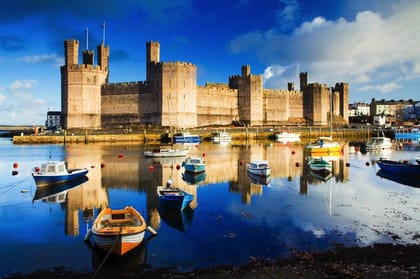
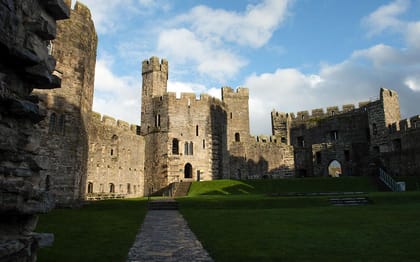
Conwy is the better ruin. Caernarfon is the better statement. Walk along the quay below its south front and the first thing you notice is that the towers are not round: they are polygonal, many-sided, and the walls are striped with bands of differently coloured stone. That was deliberate. The historian Arnold Taylor argued that Edward I's builders were echoing the walls of Constantinople, the seat of the Roman emperors, and tying the new English rule of Wales to the old Roman story of Segontium, the fort on the hill above the town. Other historians read Arthurian and Roman imagery into it too. Either way, this was a castle meant to be looked at as much as defended.
It still works. Caernarfon sits where the Afon Seiont meets the Menai Strait, and from the water or from the Anglesey shore the sheer length of its curtain wall, with the Eagle Tower at its western tip, is one of the great sights of North Wales.

From Edward II to 1969
A Norman motte-and-bailey stood here in the late 11th century. Edward I began replacing it in stone in 1283, as the administrative capital of his new northern territory, and work on the castle and town walls went on until 1330, costing somewhere between £20,000 and £25,000. Even then it was not finished: the rears of the King's Gate and the Queen's Gate were never completed, and you can still see where the plans stopped.
Tradition holds that the future Edward II was born here on 25 April 1284. Ten years later the half-built castle and town were captured and sacked during Madog ap Llywelyn's revolt, before the English retook them in 1295. Owain Glyndŵr's forces besieged it in 1401, 1403 and 1404 without taking it. In the Civil War it was held for the king and besieged three times before surrendering to Parliament in 1646, its last military action.
The modern chapter is royal theatre. The castle hosted the investiture of the Prince of Wales in 1911 and again in 1969, when the ceremony for Prince Charles was broadcast worldwide. It has been part of the Castles and Town Walls of King Edward in Gwynedd World Heritage Site since 1986, and Cadw now uses the Welsh name, Castell Caernarfon.
Tours and tickets: Caernarfon Castle (Castell Caernarfon)
 Bestseller9 hoursFrom Llandudno: Snowdonia National Park & Three Castles Tour4.9(281)from£65
 10 hoursFrom Liverpool: North Wales and Caernarfon Castle Tour4.7(256)from£56.25
 9 hoursFrom Manchester: North Wales and Caernarfon Castle Day Trip4.7(229)from£60.75
Prices and availability from GetYourGuide. We may earn a commission if you book.
What to see
The Eagle Tower
The largest tower, at the western end, was built as the grandest lodging in the castle and is crowned by three turrets. Climb it for the view across the Menai Strait to Anglesey and back over the rooftops of the walled town to the mountains of Eryri.
The King's Gate
The main entrance, facing the town, was designed as a gauntlet of doors, portcullises and murder holes. A three-year, £5 million Cadw project, completed in April 2023, put new floors into the gatehouse towers and added a glass lift and a rooftop viewing deck, so wheelchair users and others who cannot manage spiral stairs can now reach the upper battlements of the King's Gate.
The Queen's Gate and the wall passages
At the eastern end, the Queen's Gate opens high above the ground, where a ramp once led up to it. Between the towers, passages run through the thickness of the walls; walking them on a wet day, with arrow slits framing the strait, gives a real sense of how the place was defended.
The Royal Welch Fusiliers Museum
Inside the castle, the regimental museum of the Royal Welch Fusiliers is included in your ticket. It covers more than three centuries of the regiment's history and is better than most visitors expect.

Tickets and opening times
Cadw lists the usual seasonal pattern: 9.30am-5pm from 1 March to 30 June and from 1 September to 31 October, 9.30am-6pm in July and August, and 10am-4pm from 1 November to 28 February. Last entry is 30 minutes before closing, and the castle is closed on 24, 25 and 26 December and 1 January.
Cadw's standard adult ticket is £14.90, with reduced prices for juniors (5-17), students and seniors and a family ticket for two adults and up to three children; event days cost slightly more. Booking online saves 5%. Under-5s, and disabled visitors with a companion, go free. Guided tours run on some dates for a small extra charge; see the events list on the Cadw page.
The castle drew more than 155,000 visitors in 2024-25, so summer days can be busy from late morning. Plan on two hours, more if you like regimental history.
When to go, and how to spend the day
The castle is at its best on a bright, breezy day when you can see Anglesey and the mountains from the Eagle Tower, but it is also one of the better rainy-day options in the north-west: the wall passages, the gatehouse rooms and the regimental museum keep you under cover for a good part of a visit. In July and August, arrive at opening and do the towers first, before the wall-walks fill up. Winter visits are calmer and shorter, with the 4pm closing; on a crisp January morning you may have the Eagle Tower almost to yourself.
Cadw runs family events here through the year, from living history weekends in summer to seasonal trails at Halloween and Christmas, and prices on those days are slightly higher than normal. Check the events list on the Cadw page if you want to catch one, or avoid one.
A good full day in Caernarfon starts at the castle, continues with a loop of the town walls and the waterfront, and ends with lunch on Y Maes. If you have the energy, walk up the hill to Segontium, the Roman fort whose legacy Edward's builders were so keen to borrow. In season you can instead spend the afternoon on a steam train into the mountains.
Getting there
By train and bus: Caernarfon has no mainline station. Take the train to Bangor on the North Wales Coast line, then Arriva's 5C from outside Bangor station to Caernarfon bus station. On the November 2026 timetable it runs about every 30 minutes and takes around half an hour. Our guide to buses in Wales covers tickets such as the 1bws day pass.
By heritage railway: in season, the Welsh Highland Railway runs steam trains from its station near the castle through the mountains to Porthmadog.
From Llanberis: the Sherpa'r Wyddfa S1 links Caernarfon with Llanberis in about 25 minutes, roughly every two hours in winter.
By car: follow the A487 from the A55 at Bangor. There are pay-and-display car parks by the quay below the castle and around the town; they are busiest on summer Saturdays.
The town beyond the walls
Caernarfon is one of the most Welsh-speaking towns in Wales, and you will hear Welsh in the shops and on the square long before you hear English. The medieval town walls still enclose the grid of narrow streets Edward laid out next to his castle, and a slow loop round them, out along the waterfront and back through the gates, takes half an hour. The open square in front of the castle, Y Maes, is lined with cafés and pubs, and the streets just inside the walls have small restaurants and bakeries; it is easy to eat well without leaving the old town.
Weather moves fast here, with the mountains just behind; check the Caernarfon forecast before you plan a walk on the walls.
Where to stay and what to see next
Caernarfon is a practical base for the whole north-west: buses to Yr Wyddfa, steam trains to Porthmadog and a short hop to Anglesey. See hotels in Caernarfon, from guesthouses inside the walls to larger hotels on the edge of town.
From here, the obvious next step is Yr Wyddfa, on foot or by train from Llanberis. The Welsh Highland Railway starts in the shadow of the castle, and for a Victorian counterpoint to Edward's medieval power, visit the mock-Norman Penrhyn Castle near Bangor. Tours and boat trips on the Menai Strait are listed on our things to do in Caernarfon page, and the Caernarfon and Menai area guide has the bigger picture.
Caernarfon Castle (Castell Caernarfon) on video
Caernarfon Castle (Castell Caernarfon): questions people ask
Why are Caernarfon Castle's towers a different shape?
Was Prince Charles invested at Caernarfon Castle?
Is Caernarfon Castle wheelchair accessible?
How do I get to Caernarfon Castle without a car?
Is the Royal Welch Fusiliers Museum included in the ticket?
Caernarfon Castle (Castell Caernarfon) on the map
Nearby attractions

Zip World Velocity 2 (Penrhyn Quarry)
A mile-long, head-first zip line at over 100 mph across Britain's biggest slate quarry. Short, pricey and utterly memorable, with real history under your harness.

Yr Wyddfa (Snowdon)
More than 600,000 people walk up Yr Wyddfa every year. Here is how to pick a path on purpose, beat the parking, and know when the train is the smarter call.

Penrhyn Castle & Garden
A 19th-century mock-Norman castle near Bangor, paid for by Jamaican sugar and Welsh slate, with astonishing interiors and an honest account of where the money came from.

Beaumaris Castle
Edward I's most perfect design ran out of money before it reached full height. The result is a moated, symmetrical masterpiece on the edge of the Menai Strait.

Ffestiniog & Welsh Highland Railways
Two historic narrow-gauge railways meet at Porthmadog: one climbs to the slate town of Blaenau Ffestiniog, the other winds through the Aberglaslyn Pass to Caernarfon.

Portmeirion
A pastel fantasy village built over fifty years on a wooded estuary headland. Silly, beautiful and better than its postcards, especially early or out of season.
If you like Caernarfon Castle (Castell Caernarfon)
Yr Wyddfa (Snowdon)
More than 600,000 people walk up Yr Wyddfa every year. Here is how to pick a path on purpose, beat the parking, and know when the train is the smarter call.
Ffestiniog & Welsh Highland Railways
Two historic narrow-gauge railways meet at Porthmadog: one climbs to the slate town of Blaenau Ffestiniog, the other winds through the Aberglaslyn Pass to Caernarfon.
Penrhyn Castle & Garden
A 19th-century mock-Norman castle near Bangor, paid for by Jamaican sugar and Welsh slate, with astonishing interiors and an honest account of where the money came from.