
Portmeirion: Clough Williams-Ellis's Italianate village on the Dwyryd
A pastel fantasy village built over fifty years on a wooded estuary headland. Silly, beautiful and better than its postcards, especially early or out of season.
Walk down the drive from the toll booth on a damp November morning and the first thing that hits you is the colour: ochre, turquoise, salmon pink and a faded custard yellow, stacked up a wooded headland above the sands of the Dwyryd estuary. The second is the quiet. Out of season, with the coaches gone, Portmeirion feels less like an attraction than a film set after the crew has packed up, which, for anyone who knows The Prisoner, is more or less what it is.
People still argue about whether it is a masterpiece or a very expensive joke. Our view: it is both, and that is the point. Go early, go slowly and give it longer than you planned.
One man's argument in stone and paint
The architect Clough Williams-Ellis designed and built Portmeirion over fifty years, from 1925 to 1975. The site was a private estate called Aber Iâ ("ice estuary"), developed in the 1850s on the remains of an old foundry and boatyard. He renamed it: "port" for the coast, "meirion" for the old county of Merioneth.
His case, made with salvaged columns, rescued ceilings and a great deal of pastel render, was that you could build somewhere new without spoiling the landscape around it. Many of the pieces came from demolished buildings elsewhere in Britain, which is why a Georgian colonnade can sit next to a Mediterranean bell tower without anyone blinking. In 1931 he also bought Castell Deudraeth, the castellated Victorian mansion at the top of the drive; it finally opened as a hotel and restaurant in August 2001, more than twenty years after his death.
The village found famous friends early. Noël Coward wrote Blithe Spirit while staying here (which room is disputed: the Fountain suite or the Watch House, depending on whose account you trust). The exteriors of The Prisoner were shot here in 1966 and 1967, with Portmeirion playing the sinister "Village" where Number Six is held. Doctor Who arrived in 1976 for "The Masque of Mandragora", and from 2012 to 2018 the woods and piazza hosted Festival No. 6 every September.
Portmeirion is now owned by a charitable trust and run as a hotel and day-visitor attraction. Cadw lists many of the buildings; the Town Hall is Grade I, and the gardens are on the historic parks register at Grade II*.

What to see
The Piazza and the village streets
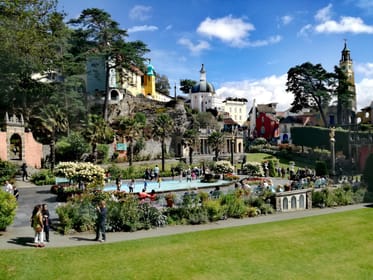
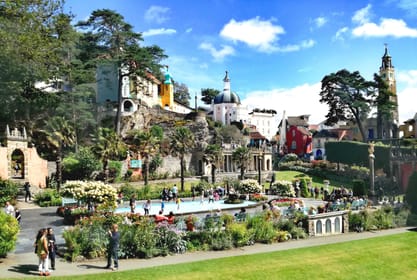
Almost every path leads down to the Piazza, a sunken lawn with a long pool and fountain, ringed by statues, steps and pavilions. Stand at the bottom end and look back up: the Pantheon's dome, the Campanile and the stacked façades are composed like a theatre backdrop, and that is no accident. Williams-Ellis was fond of false perspective, so buildings that look three storeys high from below are sometimes little more than a painted front. Climb the lanes behind for the views across the estuary to the hills of Eryri.
The Town Hall and the Bristol Colonnade
The Grade I Town Hall (Hercules Hall) is the best place to see the salvage habit at work: its elaborate 17th-century plaster ceiling was rescued from a country house that was being demolished. Nearby, the Bristol Colonnade did exactly what its name suggests, travelling from Bristol to Gwynedd stone by stone.
Y Gwyllt, the wild woods
Most day visitors never leave the village, which is a mistake. Y Gwyllt ("the wild place") is 70 acres of woodland with exotic planting, giant rhododendrons and, by Portmeirion's own count, 20 miles of paths. In May the rhododendrons and azaleas are the main event; in autumn and winter you will have long stretches to yourself, with the odd glimpse of the sea through the trees. Paths are steep in places and muddy after rain, so wear proper shoes.
The estuary shore
Below the Hotel Portmeirion the sands of the Dwyryd spread out at low tide, with the stone boat moored permanently on the quay as a favourite photo stop. Treat the estuary with respect. The tide comes in fast and creates quicksand further out, so check the tide times before you walk out and come off the sands well before high tide.
For Prisoner fans
You will recognise the Piazza, the Campanile and the Round House (Number Six's home in the series) at once. Portmeirion has embraced the connection rather than fighting it, and you can still buy Prisoner merchandise in the village.
Tours and tickets: Portmeirion
 Bestseller9 hoursFrom Llandudno: Portmeirion, Snowdonia and Castles Tour4.8(557)from£65
 9 hoursSnowdonia: Portmeirion, Snowdonia & Castles Private Tour5.0(5)from£650
 7 daysCardiff: 7-Day Private Voyage of Wales with Driverfrom£4,000
Prices and availability from GetYourGuide. We may earn a commission if you book.
When to go and how long to stay
Allow three to four hours for the village and a decent loop of the woods, a full day if you plan lunch and the beach. The colours actually glow in soft grey light, so a drizzly day is no disaster, and the Gwyllt gives shelter.
- Main season (23 March to 1 November 2026): toll booths open 9.30am, gates close 6.30pm, last entry 5pm.
- Winter (2 November 2026 to 15 March 2027): 9.30am to 5.30pm, last entry 4.30pm. Only some cafés and shops open.
- Christmas: the Christmas Fair runs on 4, 5 and 6 December 2026 (tickets on the day only), and set-up may affect some views until 11 December. The village is closed to day visitors on 25 and 26 December 2026.
Summer weekends and school holidays bring coach parties by late morning; if you can, arrive at 9.30am and do the woods after lunch, when the crowds are packed into the Piazza. Main-season dates for 2027 had not been published by November 2026.
Tickets and house rules
Winter 2026-27 day-ticket prices (valid 1 November 2026 to 14 March 2027) from Portmeirion's own ticket page:
| Ticket | Winter price |
|---|---|
| Adult | £10 |
| Concession (60+ and students) | £10 |
| Child (5-15) | £5 |
| Under 5 | Free |
| Disabled adult (with proof) | £5 (carer £8) |
Main-season prices are noticeably higher and family tickets are sold in summer; check the official tickets page before you go. Buy online at busy times, or at the toll booth on the day. Tickets are non-refundable.
A neat workaround: entry is complimentary if you have pre-booked lunch at Castell Deudraeth, or lunch or afternoon tea at the Hotel Portmeirion, and you do not need a separate day ticket. With a Castell Deudraeth booking the free entry is for after your lunch, so buy a ticket if you want to look round first.
Getting there without a car (and with one)
By train
The nearest station is Minffordd, which is served both by the Cambrian Coast line and by the narrow-gauge Ffestiniog Railway. Portmeirion puts it at about one and a half miles away: a footpath follows the driveway, then crosses the field called Cae Mawr below Castell Deudraeth to reach the tollgate. Allow around half an hour on foot. Mainline services on the Cambrian Coast have been altered while new trains are introduced, so check Transport for Wales before travelling; our guide to trains in Wales explains the network.
Arriving by steam is the romantic option. Take the Ffestiniog Railway from Porthmadog or Blaenau Ffestiniog to Minffordd and walk from there.
By bus
The TrawsCymru T2 (Bangor to Aberystwyth via Caernarfon, Porthmadog and Dolgellau, run by Lloyds Coaches) stops at Minffordd, including a stop outside the Ffestiniog Railway station. Times are on Traveline Cymru; see our bus guide for tickets.
By car
Use the postcode LL48 6ER and follow signs from the main road at Minffordd, between Porthmadog and Penrhyndeudraeth. There are large car parks near Castell Deudraeth, plus a dedicated disabled car park.
Eating, drinking and staying the night
A handful of cafés and ice-cream counters trade in the village (fewer in winter). For a proper sit-down meal, the two options are the Hotel Portmeirion, right on the waterfront, and Castell Deudraeth at the top of the drive, both of which also count as your entry ticket if booked ahead.
Staying overnight changes the experience completely. Once the gates close to day visitors, residents of the hotel and the village's self-catering cottages have the lanes, the Piazza and the sunset over the estuary to themselves. Compare options on our page of hotels and stays at Portmeirion. Staying guests can ask for a courtesy car from Minffordd station.

Combine it with
Portmeirion sits on the edge of Eryri (Snowdonia), and it pairs naturally with a few places nearby:
- Steam to the slate country: board the Ffestiniog Railway at Minffordd and ride up to Blaenau Ffestiniog.
- Across the water: Harlech Castle is visible on its rock across the bay, and it is a short drive or train ride south.
- The far west: Criccieth, Pwllheli and the wilder coves of the Llŷn Peninsula are within an easy hour.

Portmeirion on video
Portmeirion: questions people ask
Do I need to book Portmeirion tickets in advance?
Can I bring my dog to Portmeirion?
How do I get to Portmeirion by public transport?
Is Portmeirion worth visiting in winter?
Was The Prisoner really filmed at Portmeirion?
Can you get in free?
Portmeirion on the map
Nearby attractions

Ffestiniog & Welsh Highland Railways
Two historic narrow-gauge railways meet at Porthmadog: one climbs to the slate town of Blaenau Ffestiniog, the other winds through the Aberglaslyn Pass to Caernarfon.

Harlech Castle (Castell Harlech)
The sea once lapped the foot of Harlech's rock. Now the castle looks across dunes and Tremadog Bay to Llŷn and Yr Wyddfa, and a footbridge takes you straight in.

Yr Wyddfa (Snowdon)
More than 600,000 people walk up Yr Wyddfa every year. Here is how to pick a path on purpose, beat the parking, and know when the train is the smarter call.

Barmouth & Barmouth Bridge
An 820 m timber viaduct you can walk across, a flat old railway path to Dolgellau and a seaside town under a hill the National Trust was given first: Barmouth is best done slowly.

Betws-y-Coed & Swallow Falls
A cascade on the Afon Llugwy that is at its best after heavy rain, and the riverside village that has been the gateway to Eryri since the coaching days.

Cadair Idris
Southern Eryri's great mountain has no railway and no café on top, just Llyn Cau's cliffs, a roofed summit shelter at 893 m and a legend about madness and poetry.
If you like Portmeirion
Ffestiniog & Welsh Highland Railways
Two historic narrow-gauge railways meet at Porthmadog: one climbs to the slate town of Blaenau Ffestiniog, the other winds through the Aberglaslyn Pass to Caernarfon.
Harlech Castle (Castell Harlech)
The sea once lapped the foot of Harlech's rock. Now the castle looks across dunes and Tremadog Bay to Llŷn and Yr Wyddfa, and a footbridge takes you straight in.

Llŷn Peninsula (Aberdaron)
Wales's far west: a Welsh-speaking peninsula of pilgrim churches, squeaking sand and a beach pub, ending in the tide races off Bardsey.